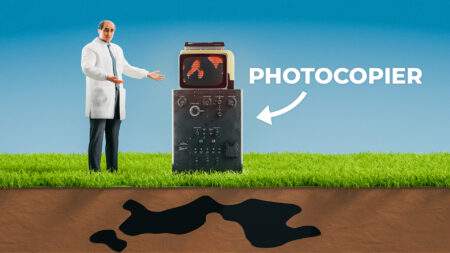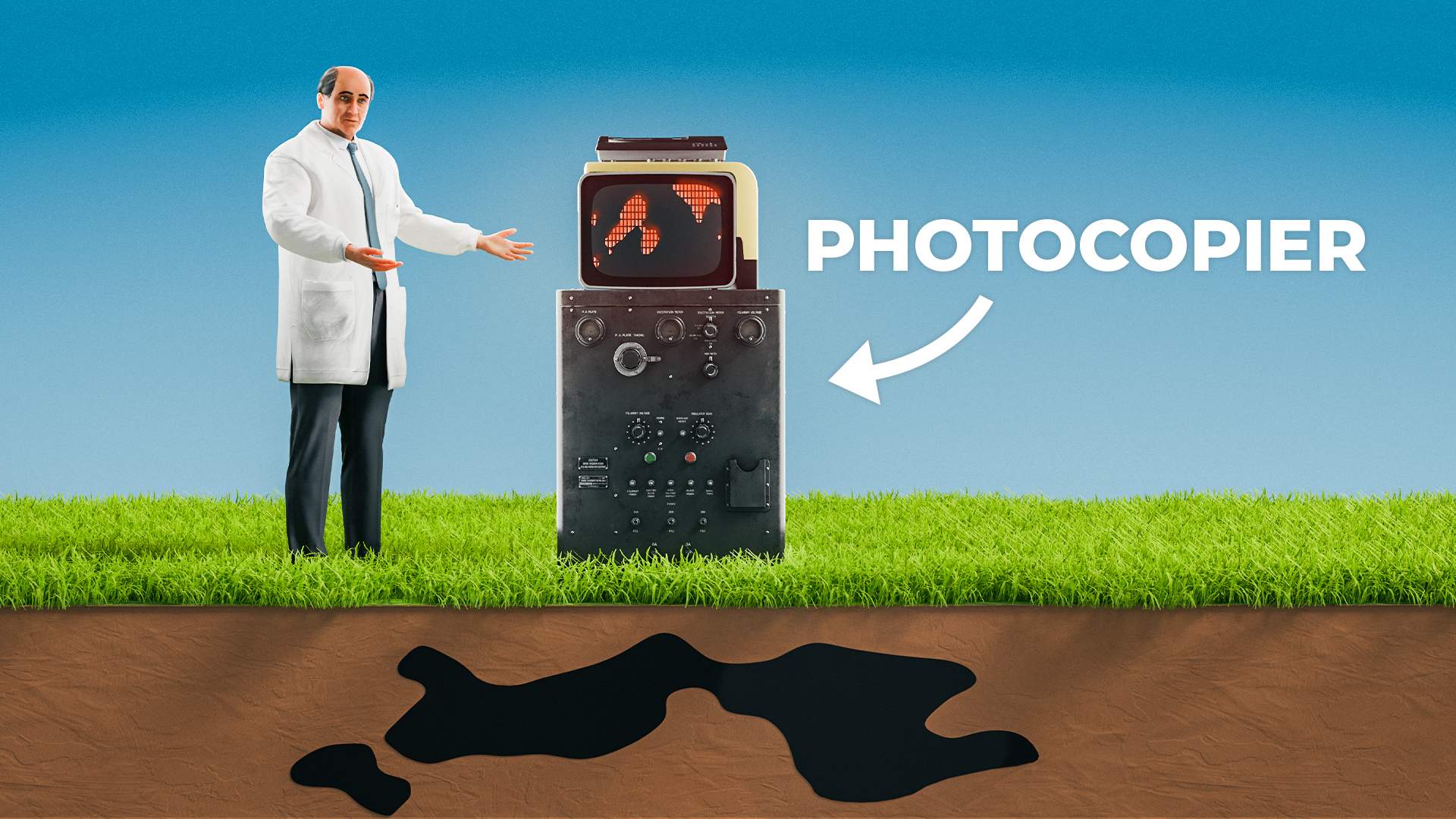

This is the oil sniffer, a plane loaded with top secret equipment, designed to detect oil. By simply flying over land, it could map out entire deposits, miles beneath the surface, with incredible accuracy.
When it first appeared in the 70s, it promised to revolutionize the oil industry, allowing countries to find and produce their own oil much more easily. That was, if it was actually real.
This is the story of two men, who throughout the 70s, tricked an entire country into spending billions on their fake machine, without finding a single drop of oil.
We modeled the entire thing, to show you how the device actually worked, why an entire country fell for it, and the mysterious network of people behind the scam.
In the mid 70s, the world was going through a crisis, an oil crisis. Middle Eastern countries had placed an embargo on their oil, causing prices around the world to skyrocket by over 300%. Getting oil became a nationale23ud3ewkefhv hsnfcdhceudewafgedrfuyges4ew4dyxaweyirkfcrjyhwaioerqhwkedgweidqiergwe4,rhf3tkdgrljheizdr priority, especially for France, which at this point, was entirely dependent on outside oil.
With its reserves getting desperately low, France decided to start looking for its own oil.
That’s where these two came in: Aldo Bonassoli, a physicist from Italy, and Alain de Villegas, an aristocrat from Belgium. They had worked together for over a decade, inventing a device capable of detecting water and minerals deep beneath the surface.
To take advantage of the current crisis, their next invention seemed obvious, an oil detector. They came up with an electrical device that could simply scan the surface from above, drastically reducing the cost and time required to find oil.
To get their invention in front of the right people, the two inventors had a secret weapon; Jean Violet; a French lawyer and member of the secret service who had connections at every level of society.
He put the inventors in touch with officials from Elf, France’s state-owned oil company. At the time, Elf had almost completely run out of oil, so they were instantly hooked by the idea of an oil detecting plane.
And so, in May 1976, the device was loaded onto a plane, and the two inventors, along with Elf’s top officials, took to the skies.
To test that the device actually worked, Elf officials told the pilots to fly over a specific location, where they knew an oil deposit already existed. If the device worked, the oil deposit should show up in the same location.
Inside the plane, advanced computers and a mess of wiring filled the front of the plane. According to Aldo, his device could send out a signal and detect the gravitational waves given off by the oil deposits. Aldo refused to give away any more info, but to Elf’s officials, this explanation sounded revolutionary.
Sure enough, as they flew over the target, the device started to beep, and images started to appear on the detection screen. To record the data, the device even printed off a map with the oil deposit overlaid on top.
Amazingly, the device was spot on. Not only did it match the correct location, but the device mapped out the exact shape of the oil field in surprisingly great detail.
To Elf, it really seemed like they had found the holy grail of oil exploration, and they were desperate not to let other countries get their hands on it.
And so, in May 1976, Elf signed a contract with the two inventors for an incredible 200 million Swiss francs, around half a billion dollars in today’s money. But that’s where things get interesting.
The contract was actually set up between Elf and a company in Panama called Fisalma, run by the two inventors. With the help of the French Prime Minister and the head of the Swiss Bank, the deal was done.
Now with exclusive rights to the device, Elf and the inventors got to work.
Over the next year, they flew multiple secret flights, successfully finding oil deposits all over Europe and South Africa.
To start reaping the benefits of their investment, Elf set up two drilling points, one in the South of France and a more promising one in South Africa.
But after months of drilling to well over 3,000 meters below the surface, not a single drop of oil was found.
The device had led the company to a dead end, and Elf’s officials were starting to get suspicious. But things were about to get a whole lot more complicated.
During the next exploration flight, Aldo announced that his device had picked up something unusual. While flying over the sea, it had detected a faint trail, which he claimed was the radiation from a nuclear submarine.
Elf took this report to the French military, and amazingly, they confirmed that it matched the real location of a French submarine.
This changed things. Not only were Elf now fully convinced by the device, but the French military had now declared it as top secret.
To avoid the device falling into the hands of another country, Elf signed yet another contract with the inventors, this time for two hundred and fifty million francs.
A whole fleet of planes were bought, employees were hired, and the company started expanding their sniffing business all over Europe. Elf had pinned its entire hopes on this device, and yet they still hadn’t found a single drop of oil.
Why were they falling for this? How could the officials not see that they were being played? Something clearly wasn’t right, and it was all about to come crashing down.
At the end of 1977, Elf’s CEO retired, leaving the new CEO to run the company. Bit by bit, he was introduced to the sniffer project, which at this point was still a closely kept secret. But after several more failures, the relationship with the inventors turned, and he became suspicious of the whole project.
And so, on the next exploration flight, he brought along physicist Jules Horowitz to analyse the device.
Since the device could in theory see through anything, Aldo offered to perform a simple test. He gave Horowitz a metal ruler and told him to place it on the detector plate, which was behind a curtain.
Meanwhile, the screen on the front of the device displayed an image that perfectly resembled the shape of the ruler. So far so good.
But Horowitz came back, only to reveal he had bent the ruler, proving that the device wasn’t actually detecting anything. Aldo had finally been caught red handed.
Elf immediately stopped all funds going to the inventors and seized the device to understand what was really going on. What they found was amazing. This is how they had been tricked.
As it turned out, Aldo wasn’t a physicist at all, but a TV repair man, with expertise in visual effects.
Behind the facade of electrical equipment, Aldo’s device was really just a large infrared camera. Before each flight, he painted abstract pictures, placed them into a black box, and lit them from behind using an infrared lamp. Since the camera was also infrared, the end result was an image resembling the natural shape of an oil deposit.
By moving the image across the camera’s field of view, it made it look like the plane was actually flying over the deposit. Aldo recorded these videos onto a VHS tape and played them back during the flight. At the right moment, he’d hit play on a remote hidden inside his pocket, and the shapes would then pass by the screen just as they were flying over the real oil deposits.
In order to know exactly when to hit play, Aldo had been fed data directly from a contact inside Elf, so he knew exactly where the deposits were.
It was the scam of the century. More than a billion dollars worth of tax payers money had disappeared, and France had nothing to show for it. The whole thing was so embarrassing that the Prime Minister decided to completely cover up the story. Documents were shredded, and the two inventors were never charged to avoid the story getting out.
After the scam, Aldo returned to being a TV repairman in Italy and Alain, who was completely broke, moved to South America.
Wait a minute! It may seem like the story is over. But after digging a bit deeper, it turns out that this scam isn’t really what it seems.
Throughout the whole thing, there was a much wider scam going on, that went under everyone’s noses.
You see, it wasn’t really Elf that got scammed, and the two inventors weren’t really the scam artists.
Neither of the inventors made any money from the scam. So what really happened?
Throughout this entire story, there was one name always lurking in the background, Jean Violet. He was the well-connected lawyer that introduced the inventors to Elf. But his involvement ran much deeper than that.
He wasn’t just a well connected lawyer. He was part of several highly exclusive political groups and private clubs. He was the founder of Le Cercle, an invite-only group where right-wing elites meet up every year, to plan and influence global politics. He was also part of Opus Dei, several other political groups, knighted by the Pope, friends with the Saudi Prince and had strong connections to the Vatican Bank.
Thanks to his secret service connections, he was able to feed Aldo with Elf’s data on where the oil fields were and where the submarine was.
When the first Elf contract was signed with the company in Panama, guess who the authorized representative was, Violet!
Over the next few years, the 200 million francs that flowed into Fisalma would go on a wild journey, filtering through various shell companies that were all in some way connected to Violet and his political groups.
For example, large amounts of money ended up in the European Academy of Political Science, an organization founded by Violet. Through this immense network, money found its way back to Le Cercle, Opus Dei and the Vatican, with Violet’s contacts conveniently in the middle taking their cut.
The web of companies and people involved in this scam ran so deep that it became impossible to keep track of where the money ended up.
Aldo the eccentric inventor, was simply a puppet, crazy enough to go along with the scam and believe in his device.
The people really involved in this story wielded so much power that no one was ever punished, and the billions of Francs that were sucked out of the French economy were never recovered.