
It was gone. In a single morning, more than 40 million dollars had just disappeared from one of France’s biggest banks. When the police finally got into the vault, it was obvious that this was no ordinary bank robbery.
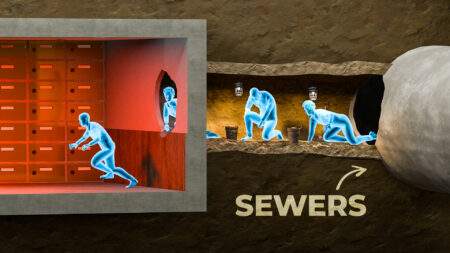
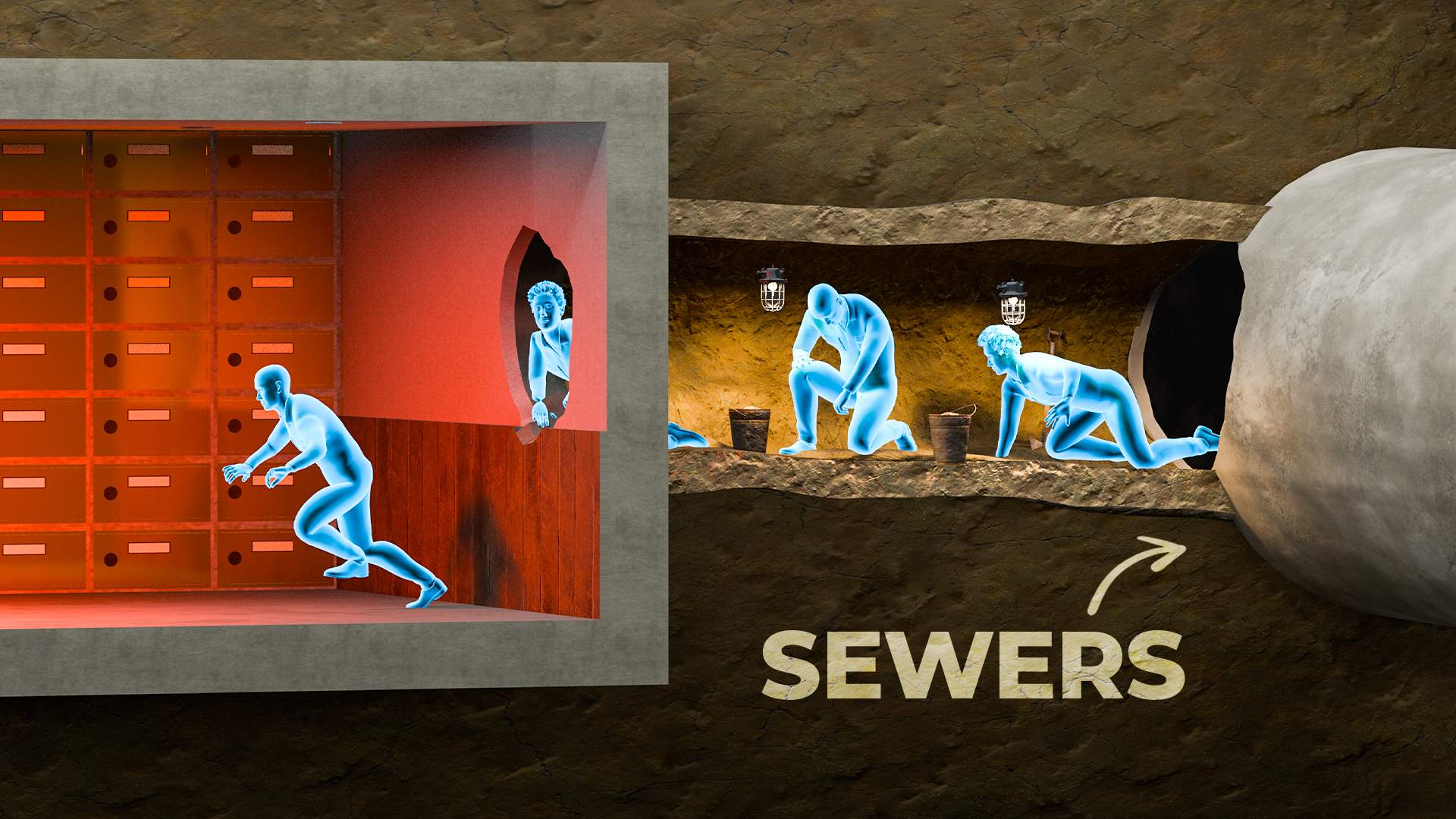
Instead of breaking into the bank itself, the thieves had tunneled all the way from the sewers and straight through the concrete walls of the vault. When inside, they ransacked the safe deposit boxes, taking gold, cash and precious jewels before vanishing back into the sewers.
It was the heist of the century, and the question was, who was behind it all?
As it turned out, a team known as the sewer rats had spent two months underground, expertly carving the tunnel, and it was all done in complete secrecy. The mastermind behind it all was Albert Spagiarri, a known criminal and personal photographer of the city’s mayor.
Albert Spaggiari
It’s not everyday that you suddenly decide to rob a bank – but in September 1974, that’s exactly what happened to Albert Spaggiari.
He had just become a customer of the Societe Generale, and went to drop off some money into his safe deposit box. When he was inside the vault, he noticed something interesting. There wasn’t a single alarm in the entire vault.
To make sure he was correct, the next day he placed an alarm clock inside his safe deposit box and set it to go off at 1 am. If there was an alarm, surely the sound of his clock would trigger it.
That evening, Albert waited in a bar across the street, and when 1 am arrived, nothing happened. Things were about to get interesting for Albert.
The sewers
Over the next few months, he went back to the vault, taking notes about its layout and even taking pictures. At this point, he knew he was going to rob the bank, but he still had no idea how.
Then, when he was scoping out the exterior of the bank, he overheard a conversation.
Man 1: Have you heard they’re planning on building a subway in Nice?
Man 2: A subway? I thought they couldn’t build anything underground here because of the Mediterranean?
Man 1: Jesus Christ, don’t you know about the massive underground sewers?
Man 2: Nice has big underground sewers, like in Paris?
Man 1: Of course you idiot, you can drive a truck through the sewers they are so big.
Suddenly it clicked in Albert’s head. Nice used to have a river running through its center, where many of the old sewer lines fed into. But after decades of building on top of the river, this area was now completely underground, and enormous tunnels had been built to handle the river during a flood.
If one of these sewer tunnels went anywhere near the bank, it could allow Albert to dig his way into the vault without anyone noticing.
By pretending to be a local builder, Albert managed to get his hands on blueprints of the city’s sewer system.
According to these, there was a ramp underneath the convention center that led down into the city’s main sewage tunnels. From there, a service road inside the tunnel followed the old river, until it reached the massena plaza. Then, a smaller sewage tunnel broke off and ran underneath the streets – and crucially, right past the bank.
But from there, Albert still needed to cover the 30 feet distance to the vault and somehow crack through the 6 feet thick concrete walls. He needed a team.
Recruiting the gang
Being the well connected criminal that he was, he quickly pulled together a team of around 20 men – contacts from the Marseille mafia and old comrades from his time in the war. He had tunneling experts, plumbers, electricians, welders. These guys were professionals, and all they needed now was the equipment.
To be extra cautious, Albert travelled all across France and Europe, buying things in small quantities to leave no obvious trace. He bought flashlights, hammers, drills, buckets, cables, cement, waterproof overalls and just about everything needed to tunnel through the ground.
The idea was that all of the equipment left behind after the heist would lead the police on a wild goose chase, one that would ultimately lead them nowhere.
With everything bought, the sewer rats could now start digging.
Digging the tunnel
Some of the team entered the sewers via the ramp, and drove over a mile to reach the sewage tunnel. From there, they had to walk around 300 meters to reach the crucial digging point.
The rest of the gang entered the sewers through an access room in an underground parking garage. From there, the crew ran an enormous electrical cable from an outlet in the parking garage down into the sewers, giving them power for lights and tools.
Like a well oiled machine, they started drilling, removing tonnes of rock and piling it up in an unused part of the sewer.
To avoid any suspicion from the town’s sewage workers, they cemented up the entrance of their tunnel to make it look identical to the other tunnel entrances, even using the exact same color of paint.
Once they were done for the night, they’d leave all of their equipment covered up inside a hole in the tunnel and quietly make their way out.
For 2 months, the team went down into the sewers and worked on their tunnel. They had lighting, air extraction fans, beds and picnic tables. The tunnel itself was a work of art, with proper structural support and cemented walls.
Many of the crew were above ground on lookout, with radios that allowed them to warn the crew if anyone was entering the sewers. The whole operation was so professional and after 2 months of straight digging, they knew they had to be getting close.
Arriving at the vault
Then, one night in July, the crew finally hit the concrete walls of the vault, they had arrived!
But the timing was terrible. That weekend, the President of France had made a last-minute visit to Nice, and there were enormous amounts of police and security in the city. It was not the time to be robbing a bank.
Albert decided to call off the heist until the following weekend, which was a holiday weekend. This meant that the bank would be closed, giving the crew more time to break in and get as much as possible.
Saturday the 17th of July. After hours of chipping away at the reinforced concrete, the sewer rats now had their first glimpse inside the vault. The bank would be opening up on Monday morning, so the crew had just over 30 hours to get in, take as much as possible and leave through the sewers without getting caught.
Later that evening, the hole was finally big enough for the gang to enter the vault. After months of digging, the crew were finally in the place they had been dreaming about. It was time to start the heist.
The Heist
Over the next 30 hours, the gang went crazy, prying open the safe deposit boxes and taking as much as they could. They found everything; stacks of gold bars, cash, jewels, stock certificates, and even some saucy photographs of high up politicians, which the crew hung on the walls of the tunnel.
They had well and truly hit the jackpot, but it wasn’t so easy. The safe deposit boxes were much harder to break into than expected, and after 30 hours, the crew had only opened 300 out of the 3,000.
But it didn’t matter, they had already found an enormous amount of treasure. That night, the crew finally took a break, had dinner inside the vault and celebrated with bottles of red wine. They had done it!
But time was almost up, and at 5 am on Monday morning, they packed up the last bit of treasure and left the vault, leaving behind one final message on the wall: without weapons, without hatred, and without violence. They loaded the stash into the getaway car, and disappeared into the city, just before sunrise.
The aftermath
A few hours later at 8am, the bank was getting ready to open. One of the workers went to open the vault door, but surprisingly, it didn’t move. The lock mechanism was working perfectly, but the door just would not open. As it turned out, just before the crew left the vault, they had welded the door shut, buying them some extra time.
After several hours of confusion, the bank decided to drill their way into the vault, and only then was it obvious what had happened.
It might seem like the police had a lot of evidence – equipment had been littered all across the vault and in the sewers, surely something would lead to one of the thieves. But amazingly, not a single fingerprint was found. The crew had worn gloves the entire time. Even the urine came back with no results, since multiple people had urinated in every single bottle. Albert and his crew had thought of everything.
But what he didn’t know was that the events that would lead to his arrest had already taken place two weeks before the heist.
2 weeks before
Up in the mountains, the police were called to a villa. Normally this villa was empty, but the neighbour had seen a suspicious group of men constantly leaving and entering the villa. When the police questioned the men, they simply said that they had permission from the owner to use the villa. Something wasn’t right, but there was nothing more the police could do, so they took down the names of the men and left.
But when the heist later became headline use all over the country, the police officers couldn’t shake their suspicion that the villa had something to do with the heist. And so, they got a search warrant and returned to the villa.
After 100 days of the investigation leading nowhere, they were about to get their first clue.
Inside the villa, the place was full of tools, equipment and dirty clothes, all identical to those found in the sewers.
Two of the men from the villa, Alain Bournat and Francis Pellegrin were arrested, and almost immediately, they told the police everything, even naming Albert Spaggiari as the mastermind behind the whole thing. The police were finally getting somewhere, now they had to find their biggest target.
Albert flees the country
But Albert was gone. Just a few days after the heist, he fled the country and spent the next two months travelling through Guatemala and the US. When he was there, he even made a phone call to the CIA, and admitted to being the mastermind behind the heist. He was getting over confident, and eventually returned to Nice and continued living his life.
Then one morning, while having lunch with his wife in a cafe, Albert was approached by the waitress.
Waitress: Mr Spaggiari, there is a woman outside that would like to speak to you.
Spaggiari: Uhh who could this be?
When he walked out, he was instantly surrounded by police officers and arrested.
Over the next 36 hours, the police interrogated Albert, but he refused to give them any information. It wasn’t until his first court appearance that he finally started to talk.
Spaggiari: I have no regrets. I did not act for personal gain. I carried out a military operation. You can’t imagine what we found in the vault. The value of the jewels alone far surpassed the gold and the cash. I did not keep one penny of my share of the loot. The money went to help the poor people of Yugoslavia, Portugal and Italy.
Very little of what Albert said in court was accurate – he was just playing with the police and wasting the judge’s time. Over the winter, Albert went to court every week, and continued to give vague and inaccurate information.
But on his 20th visit to the court, things would go a bit differently.
Albert’s great escape
As always, Albert was taken up to the judges office, where the police uncuffed him and locked the doors. The week before, Albert had promised the judge that he would give him a detailed description of how the heist went down.
Suddenly, Albert ran to the nearest window, threw it open and jumped out. He landed on a ledge, rolled and jumped onto a car that was parked below, making a giant dent in the roof. Right beside the car was a motorbike, with the rider revving its engine. Albert hopped on, and in just a matter of seconds, he was gone.
Within 10 minutes, the French borders were closed and all flights leaving the country were cancelled. But it was too late, Abert had vanished.
Albert the free man
A few months after his escape, he sent a picture of himself to a local newspaper saying “Greetings from Albert!”. He even sent the owner of the car that he damaged 600 dollars, and an apology note.
As it turned out, Albert had fled to South America, and with the help of plastic surgery and a wig, he was now living in disguise.
Here he is with Ronnie Biggs, the man behind the Great Train Robbery.
In France, the courts had sentenced him to life in prison, but he still managed to come back every now and then to visit his mom and his wife.
In the end, just 4 men were convicted and only served about 6 months in jail. Albert lived the rest of his life as a free man, until he eventually died of cancer in 1989.