

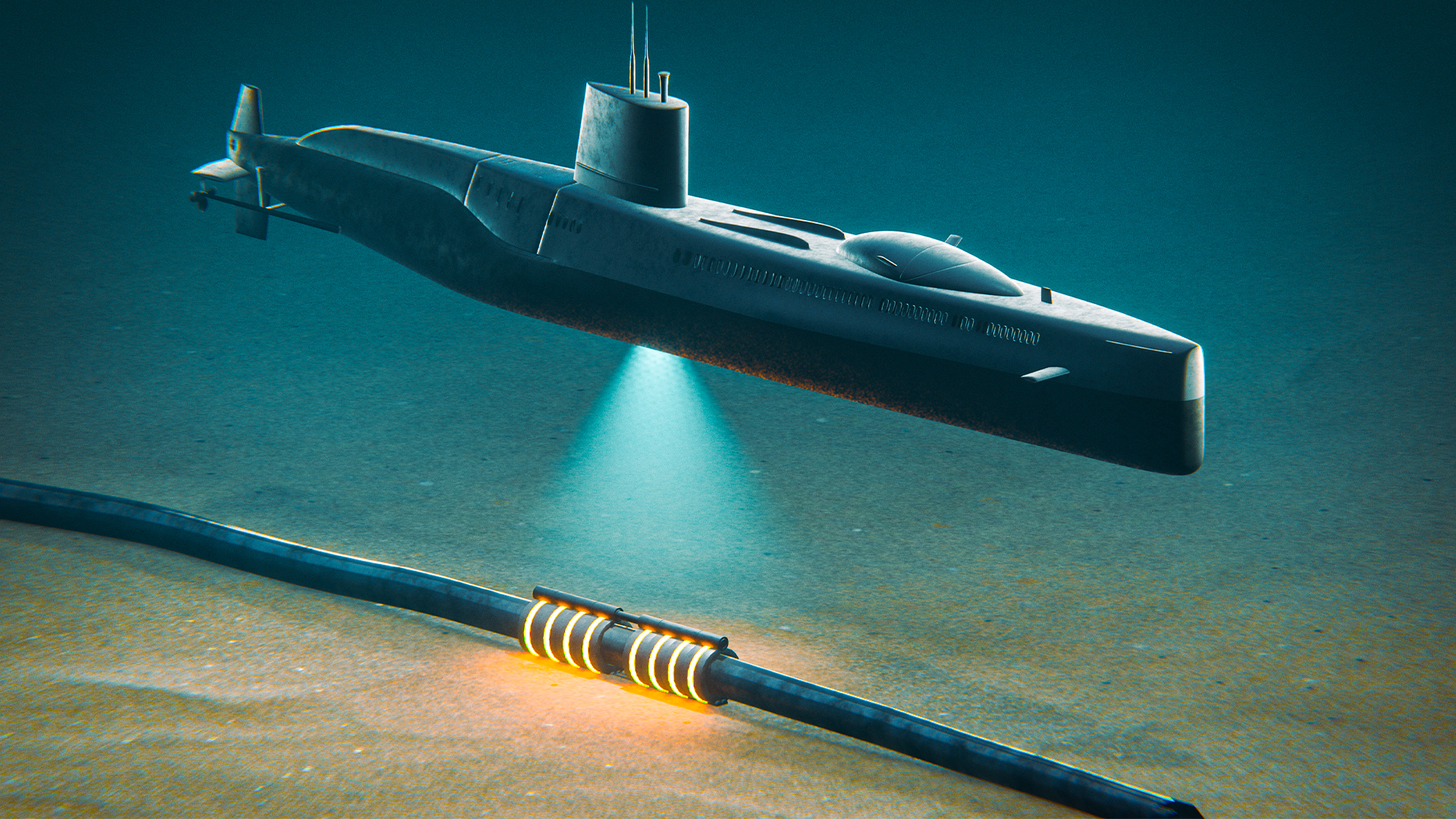

October 1971. An American spy submarine has just crossed into Soviet waters, an area completely off-limits to outsiders. Most people onboard the submarine have no idea why they’re here, but some do.
They’re searching for an underwater telephone cable that connects a brand new Soviet nuclear base to its headquarters over 1,000 miles away.
Attached to the submarine is a custom-made device, designed to wrap around the cable and record every bit of information that passes through it.
For 10 years, this device secretly fed the Americans with a gold mine of information, until one day, it vanished.
By 1970, the US and the Soviet Union were deep into the Cold War – and the constant threat of nuclear attacks meant that both sides were desperate for any bit of information they could get their hands on.
The US learned that a brand new nuclear submarine base had just been built in Petropavlovsk, a remote mountainous area in the far east of Russia. It seemed strategically positioned for an attack on the US, and so the Americans made it their goal to start spying on the base.
But instead of sending in real spies or relying on satellite imagery, they wanted something more substantial, something that would feed them with constant information, directly from the mouths of the Soviets.
Captain James Bradley, director of undersea warfare was studying a map of the region, when it suddenly hit him.
Since the base was in such a remote location, the Soviets needed to have some way of communicating with the headquarters back in Vladivostok. Radio would have been too easy to hack, and so he came to the conclusion that they must have run an underwater telephone cable through the Sea of Okhotsk.
If such a cable did exist, intercepting it could give the Americans all they needed to know about the Soviet’s nuclear capabilities. It was an idea too good to turn down.
And so, with the help of the CIA and the Navy, Operation Ivy Bells was officially underway.
But finding a cable hundreds of feet below such a massive expanse of sea seemed like an impossible task. Luckily, Captain Bradley once again had a plan.
He remembered back to his childhood along the Mississippi river, where signs would warn fishing boats wherever there was an underwater cable. If the Soviet cable did exist, he was sure that there would be similar signs along the Russian coast.
After a month-long journey, the USS Halibut finally entered the Sea of Okhotsk. The crew began slowly creeping up the coast, inspecting the shoreline through a periscope.
It took over a week of constant searching, but amazingly, they finally came across exactly what Captain Bradley had imagined.
The submarine anchored itself in place and a team of divers made the dangerous 400 feet descent to start installing the wiretap.
The device worked by induction, and so when a conversation was sent through the cable, the electric pulses would be picked up and recorded onto a tape recorder inside the device. If the Soviets ever tried to raise the cable for maintenance, the device was designed to detach and sink to the bottom of the ocean.
After a month of recording, the submarine returned to the device, and the tapes were sent back to the US to be decoded and translated by Ronald Pelton, an NSA analyst who was fluent in Russian. When the team received the first transcripts, they were amazed.
The device had picked up thousands of conversations between high ranking Soviets, openly talking about what kind of nuclear weapons they had, their range limitations and how ready they were to be put into use.
As it turned out, the Russian missiles were much less advanced than the US once feared, and conversations picked up by the device also revealed that the Soviets were constantly being held back by mechanical failures and a lack of parts.
Thanks to the wiretap, the Americans also knew exactly when and where Soviet submarines were heading out to sea, allowing them to quietly follow them at close range.
All of this was crucial information that completely changed how the US attacked the Cold War.
Every month, the USS Halibut would return to the cable to retrieve the tapes and replace the battery, eventually installing a more advanced wiretap that could record for an entire year.
Several years went by, and the device just kept feeding the US with crucial information. But it was all about to come to a mysterious end.
After an entire decade of secretly spying on the Soviets, the US wiretap at the bottom of the ocean was about to go silent.
In 1981, an American surveillance satellite showed a group of Soviet ships hovering around the exact spot where the device was located. The US immediately sent a submarine out to try and recover the device before the Soviets found it. But, it was too late, the device was gone.
Only a handful of intelligence officers even knew the wiretap existed, so how after 10 years did the Soviets suddenly pinpoint its exact location?
As it turned out, the Americans had a spy in their midst.
It all started a year earlier, when a strange phone call was made to the Soviet Embassy in Washington. The caller claimed to have crucial information for the Soviets, and wanted to arrange a meeting in exchange for cash.
At the embassy, the man met with KGB Officer Vitaly Yurchenko and started telling him all about Operation Ivy Bells; where the wiretap was located, how it worked, and what the Americans had learned through the cable.
As it turned out, the mysterious man was none other than Ronald Pelton, the American analyst who translated the wiretap’s messages.
His life had fallen apart; he no longer had his job at the NSA, his wife had left him and he was now bankrupt with over $60,000 of debt. And so, in a desperate attempt to make money, he called up the Soviet Embassy and decided to sell his secrets.
Pelton had just given away one of America’s most top secret missions, and it was essentially all for nothing, since the Soviets only paid him $35,000.
He was still massively in debt, and it was only a matter of time before he got caught.
Ironically, the FBI had already wiretapped the Soviet Embassy’s phone lines, and became instantly suspicious when they heard the call. But Pelton never gave away his name, and so they had no idea it was him.
Over the next few years, Pelton continued to meet with KGB officers in Washington and Vienna, supplying them with everything he knew about America’s attempts to spy on the Soviets.
But it was all about to come to an end in one final twist.
Several years later, KGB Officer Yurchenko who had taken Pelton’s initial call was on an assignment in Rome. While touring around the Vatican, he mysteriously slipped away from his colleagues and headed straight for the US Embassy. When he was there, he announced that he wanted to change sides and start working for the Americans. He was doing the exact same thing that Pelton did.
Almost immediately, he was flown over to the States and put into a safehouse in Virginia, where the CIA began questioning him. It wasn’t clear exactly why Yurchenko had suddenly switched sides, but according to him, he wanted to rekindle an old romance with a lady from Washington. It was all very suspicious, but right away, he started to give the Americans some interesting information.
Although he didn’t have a name, he told them that the man who revealed the wiretapping secrets was an NSA analyst with red hair.
It wasn’t much to go on, but the FBI compiled a list of red-haired analysts and listened back to the recordings of the phone call, and sure enough, it matched with Ronald Pelton’s profile.
They tracked him down and arrested him, and almost immediately, he admitted to spying for the Soviets. Pelton was given 3 life sentences and ended up serving 30 years in prison until 2015, the longest ever sentence served for espionage at the time.










Ronald Pelton passed away in 2022 and it was discovered in June 2026 that his remains somehow made it into the Alabama National Veterans Cemetery against laws that prevent persons convicted of federal capital crime to be intumed there. An investigation is under way.