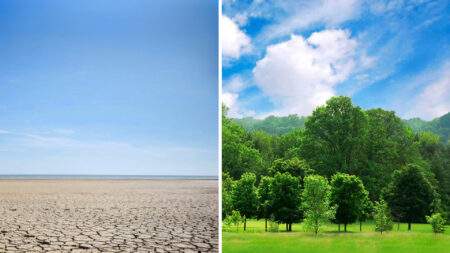

There were no lush forests, no soil, and grass wouldn’t exist for another 300 million years. It was almost impossible for anything to survive on land. So where did trees come from?
Despite this desolate landscape, there was one strange form of life that towered over everything.
These are Prototaxites, giant living organisms that once stood up to 25 feet tall. Although they look like early trees with their wood-like trunks, these mysterious creatures weren’t trees at all.
Instead of being made from an organized network of long woody fibers, Prototaxites had a messy network of interwoven tubes.
Unlike trees, they didn’t use photosynthesis to survive, and instead got all of their nutrients from the ground. Because of this, scientists generally thought they were some kind of giant fungus or mushroom.
But a recent study of Prototaxite fossils showed that the organic compounds left behind had no resemblance to fungi at all. Amazingly, it seems like Prototaxites were an entirely different form of life altogether.
For millions of years, these things dominated the landscape and helped pave the way for trees to eventually take over.
But how?
At some point in Earth’s history, all life existed in the ocean. Without soil or nutrients, land was an impossible place to survive. But deep inside the rocks, the nutrients needed to support life did exist. It was just a matter of getting them out.
With the help of waves, complex life forms like fungi and algae got pushed closer to the water’s edge and started to settle on the rocky shores. From there, the fungi used their powerful acids to break down the rock and release the nutrients trapped inside.
The algae used these nutrients to grow, and in exchange, gave the fungi special sugars that it made through photosynthesis. The two organisms had formed a close symbiotic relationship, and started spreading further inland.
Over time, the fungi and algae eventually died and decomposed, leaving behind a loose, thin layer of organic matter. Crucially, the Earth’s surface now had the key ingredient that would allow life to explode onto the land, soil.
Not only was it full of nutrients, it acted like a sponge, allowing water to be stored inside. It also provided the perfect base for algae to anchor itself to the soil.
For the first time in Earth’s history, plants that were trying to grow on land didn’t have to mine the rock. The nutrients were right there, ready to be used.
Because of this, the fungi and algae started to conquer the land, building on the soil that previous generations made before them.
These tiny organisms were about to evolve into every single plant and tree we’ve ever known.
In order for the first life on land to go from algae to the first ever tree, some evolutionary breakthroughs had to happen.
Although it wasn’t optimized for the dryness of land and the intense sunlight, very gradually, the algae started to evolve.
Its cell walls grew thicker and it developed a waxy outer layer to stop the water from evaporating. This, however, made it much harder for the algae to absorb carbon dioxide, which it needed for photosynthesis.
To get around this, it developed tiny little pores that could be opened and closed to let the carbon dioxide in and to let oxygen out.
Instead of relying on a single egg to reproduce, they developed tiny spores at the top of the plant. These would get carried by the wind, land much further away and grow into a brand new plant.
By this point, the algae was no longer algae. It had evolved into an embryophyte, with tiny leaf-like surfaces to absorb light and roots that helped anchor it into the soil.
Bit by bit, these moss-like plants started spreading further inland. But without direct access to water, surviving became almost impossible. Once again, they had to evolve.
At the bottom of the plant, dead cells started to collect and form into small lumps. Eventually, these grew more and more, pushing the leaf higher and forming a hollow tube below. Inside the tube, water could now be stored and transported all the way from the ground up to the plant’s leaves.
More tubes started branching off from the main stem, and eventually we arrived at the first plant with its own plumbing system, the Cooksonia. No longer did it need to be directly on top of a water source. Instead, it could spread out and conquer the land much more easily, finding pockets of water and maximizing its sunlight capture.
But these tubes also gave the plant some strength – and for the first time ever, plants started to fight gravity and grow upwards. This started the height war that would eventually lead to trees.
With more and more plants fighting for the same resources, a plant that grew taller than its neighbours would guarantee itself more sunlight, while also shading its competition. On top of that, the reproductive spores from a taller plant would travel further in the wind, allowing it to quite literally spread its seed further than any other plant.
But growing tall wasn’t easy for these early plants. The vascular tubes that carried the water were soft and thin. The taller the plant grew, the more weight it had to support. If they wanted to keep growing taller, they needed a much sturdier material. They needed wood.
Luckily, long before algae left the water, it had developed a crucial ingredient called lignin, which protected it from the Sun’s intense UV radiation.
But when plants started conquering land, the lignin started bonding together and turning the soft plant stems into sturdy wood-like structures. This breakthrough was about to turn plants into giants.
But amazingly, one form of life beat them all to it, the Prototaxites. While every other plant was just starting to reach a few inches tall, Prototaxites had already established a completely separate but almost identical copy of lignin. This allowed them to grow into enormous living beings – and that had a huge impact on the soil.
Their enormous network of inner tubes would have loosened up the soil, allowing oxygen and water to get in and make it more fertile. Whenever a Prototaxite died, it would decompose a huge amount of organic matter back onto the ground.
They weren’t alone, but Prototaxites acted as massive soil producers, laying the foundations for the forests that were about to take over.
Eventually, the lignin in plants caught up, and these wood-like stems started reaching far beyond the height of Prototaxites, finally evolving into the Wattieza tree.
At this point, trees started taking over, and lush forests began colonizing Earth’s surface, reaching far beyond 100 feet tall. Trees had well and truly won the evolutionary race, and Prototaxites eventually went extinct.