
This is Lawrence Sperry, aviation pioneer and certified daredevil. He’s about to fly his plane past a group of judges at the Paris aviation contest. All of a sudden, his assistant climbs out onto the wing of the aircraft, causing it to suddenly veer to the right. Instead of correcting it, Lawrence takes his hand off the controls, and miraculously, the plane steers itself back on course.
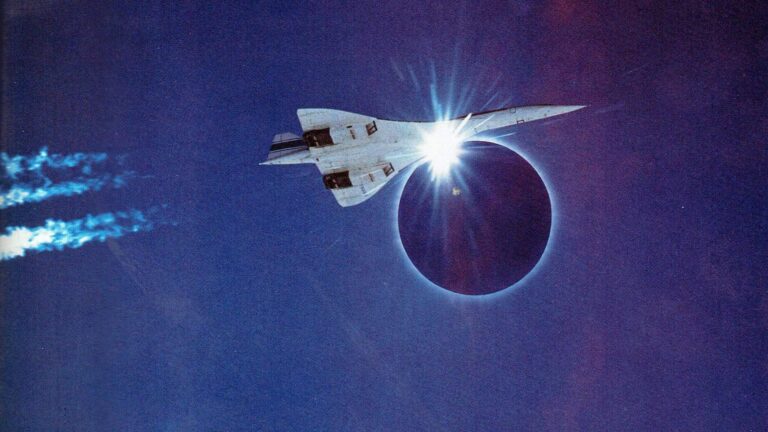
This is a real photo of that exact moment.
On the next pass, Lawrence himself climbs out onto the other wing and the plane continues to fly perfectly straight past the judges.
Sperry had invented the world’s first autopilot. Oh and it won him the competition.
By taking a gyroscope and connecting it to the plane’s rudder and elevators, the gyroscope would command the controls to keep the plane completely level.
Using a gyroscope in this way was an engineering breakthrough, and it went on to be used in everything from cars, ships, rockets, all the way to today’s phones. Over the course of 100 years, all of this technology was condensed down into a tiny chip just 1mm wide, and because of this, your phone knows its position in space at all times. But how does this work?
The basic principle of a gyroscope is that if you spin a disc really quickly, its angular momentum tries to keep it perfectly stable. By placing the disc in a 3 axis gimbal with very little friction, everything else will move around it, but the disc will stay locked in place.
By measuring how much the gimbals have moved relative to the disc, you can accurately measure how much the object has rotated.
In the midst of World War 2, Nazi Germany came out with this, the V2 rocket. This was a long range missile, designed to strike major cities from up to 200 miles away. It was one of the first advanced rockets ever built, and it was guided by a pair of gyroscopes, similar to those used on Sperry’s plane.
During the flight, these would keep the rocket on a planned trajectory, and when the rocket reached a certain speed, it would cut off its engines and fall ballistically onto its target. But in order for this to work, it also had to know how fast it was going.
In another part of the guidance system, it used a very basic accelerometer to measure changes in speed. This was essentially just a spinning disc with a weight added to one side. The disc could tilt around this axis and the whole unit was on a platform that could rotate around the vertical axis.
When the disc was up to speed, it would keep it and the weight locked in place. But when the rocket accelerated, the weight would want to stay where it is, due to Newton’s 1st law of motion. This would add a force to the disc, causing it to tilt over.
As we know, if you try to tilt a fast spinning gyroscope, it will cause it to rotate around the vertical axis, this is called precession.
The rocket’s acceleration would cause the disc to tilt, and in turn, the whole gyroscope would precess. The more the rocket accelerated, the more the gyro would precess. And so by measuring exactly how much it precessed, the onboard computer could measure its acceleration.
By accumulating all of these acceleration measurements over time, the current speed of the rocket could be calculated.
It was a genius system, but in practice it didn’t work very well. The V2 was inaccurate, often missing entire cities by up to 10 miles. Over time, the small amount of friction in each gimbal built up, and gradually caused the gyroscope to drift off course.
This problem plagued gyroscopes for decades. But no matter how smoothly they were made, there was no way to completely remove the friction. That was, until they invented this, the ring-laser gyroscope.
With these, there were no moving parts. A laser would emit a beam of light in two opposite directions. Both beams were then redirected via a system of mirrors onto the same light sensor.
Under normal circumstances, the beams of light would travel the exact same distance and hit the sensor at the exact same time. Since both beams have the exact same frequency, they should show up perfectly in sync. But if the gyroscope rotates, one beam of light will have to travel a slightly greater distance than the other one, and will therefore arrive slightly later.
The sensor would pick this up as a slight shift between the two frequencies. The more the object rotated, the more out of phase the two frequencies would be.
These ring-laser gyroscopes were a major breakthrough in accuracy and they could be made much smaller than mechanical gyroscopes. Throughout the 80s, they started being used in everything from rockets to airplanes, replacing the old mechanical gyroscopes. To this day, ring-laser gyroscopes are still used in today’s passenger airplanes.
But as technology developed, the need for an even smaller gyroscope grew – and that’s where we are now.
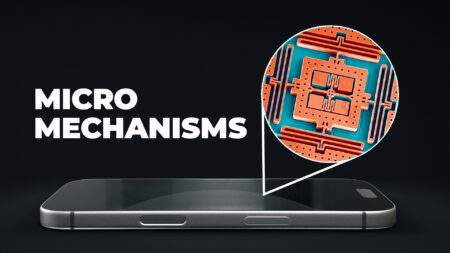
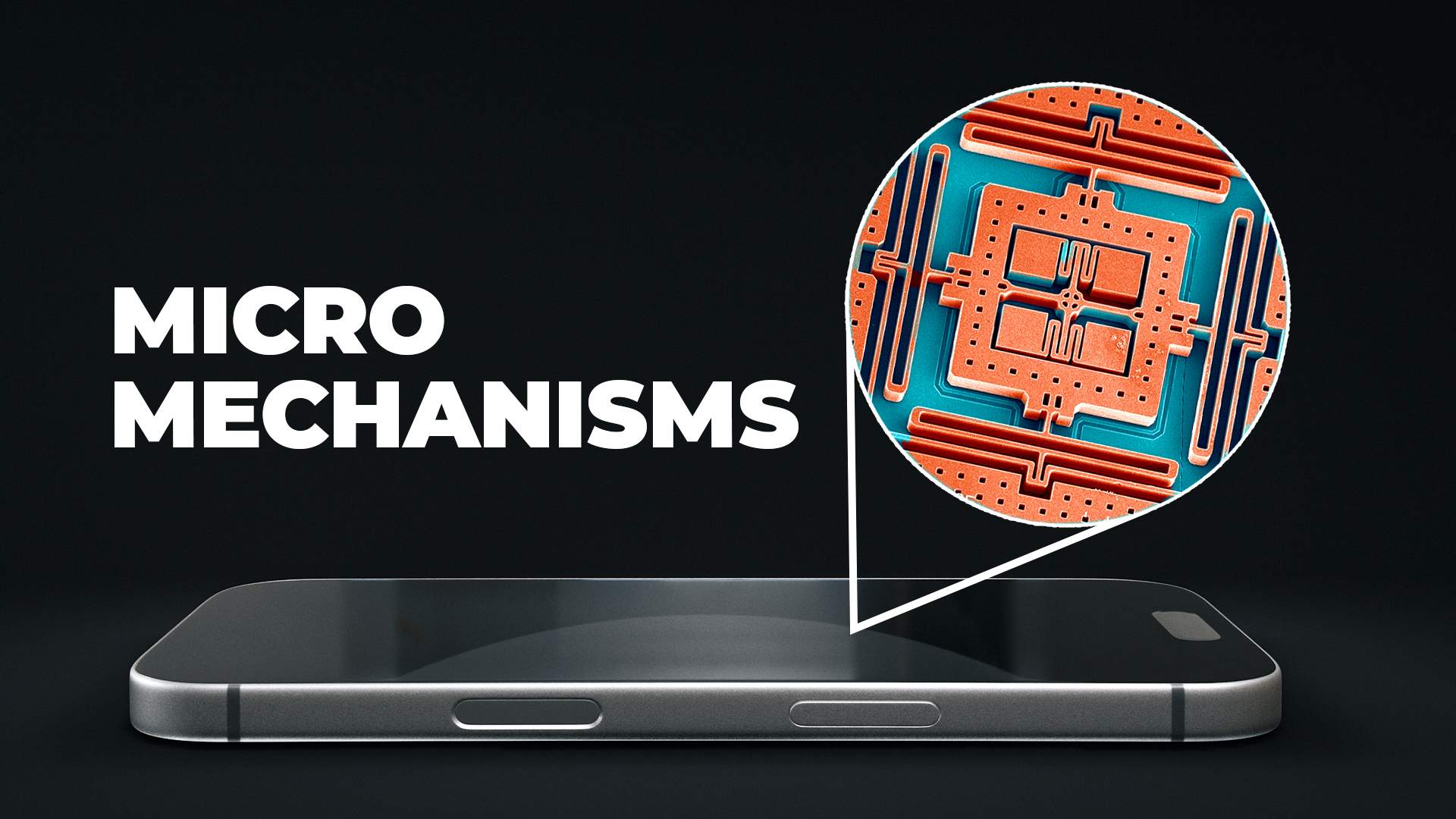
This tiny little thing is a MEMS device, and it’s why your phone always knows exactly where it is in space.
It takes all of the concepts of the original gyro and compresses them down onto a chip just 1mm wide. Inside, it’s made up of several smaller parts, 3 accelerometers and 3 gyroscopes, one for each axis. The intricate details that detect the movement are so small that a bacteria could easily fit between them.
To see it working in action, you’d need a microscope. But we don’t have one, so here’s an animation.
First, let’s look at how the accelerometers work.
Each one is made up of 2 main parts. At the center, there is a structure with sensing fingers that is allowed to move back and forth. This sits neatly inside a fixed structure that also has sensing fingers but cannot move.
Together, these 2 parts form a capacitance which is picked up by the sensing fingers.
When the object accelerates in this direction, the central structure will want to stay where it is, just like the mass in the V2 rocket. This will push the central structure in the opposite direction relative to the fixed structure. If we zoom into the sensing fingers, the capacitance here will go down, and the capacitance here will go up. The more the object accelerates, the more it will affect the capacitance. By taking the data from all 3 accelerometers and plotting it over time, the phone’s computer can figure out its movement in 3D space.
For the gyroscopes, things are a little bit trickier.
A separate part within the central structure is made to constantly oscillate back and forth at an exact frequency. Sensing fingers on the outside measure the capacitance, which should form a constant wave.
When the object rotates around this axis, it causes two parts at the center to tilt out in opposite directions.
This is much easier to understand if we look at a simple tuning fork, with both sides vibrating in sync. If we start to rotate the tuning fork like this, thanks to the coriolis effect, it pushes each fork out in opposite directions.
In the gyroscope, the rotation of the object causes the inner sections to tilt in opposite directions. When these sections move, the resonant frequency of the structure changes slightly.
This slight change is picked up by the sensing fingers as a slightly lower or higher frequency. When all axes are combined together, the phone’s computer can calculate its exact orientation in space.
Perhaps nothing shows the last century of technological evolution more than these gyroscopes.