
Paris, 1746. Two hundred monks have been arranged into a line, each connected by a wire, forming a human chain over a mile long. At the end of the line, French scientist Jean-Antoine Nollet is about to connect the final monk to a leyden jar, a primitive battery that stored high-voltage static electricity.
His goal is to demonstrate to the public, who have never even heard of electricity, just how fast it travels down a line.
Without warning, he connects the battery, and to everyone’s surprise, all 200 monks are shocked at the exact same time.
As it turned out, electricity didn’t just travel fast, it appeared to be instantaneous. This was a huge breakthrough. If electricity could travel long distances at instantaneous speeds, could it be used to deliver messages across the country, or perhaps, around the world?
This question started one the most innovative periods in human history, and eventually led to the internet. No, not that internet.
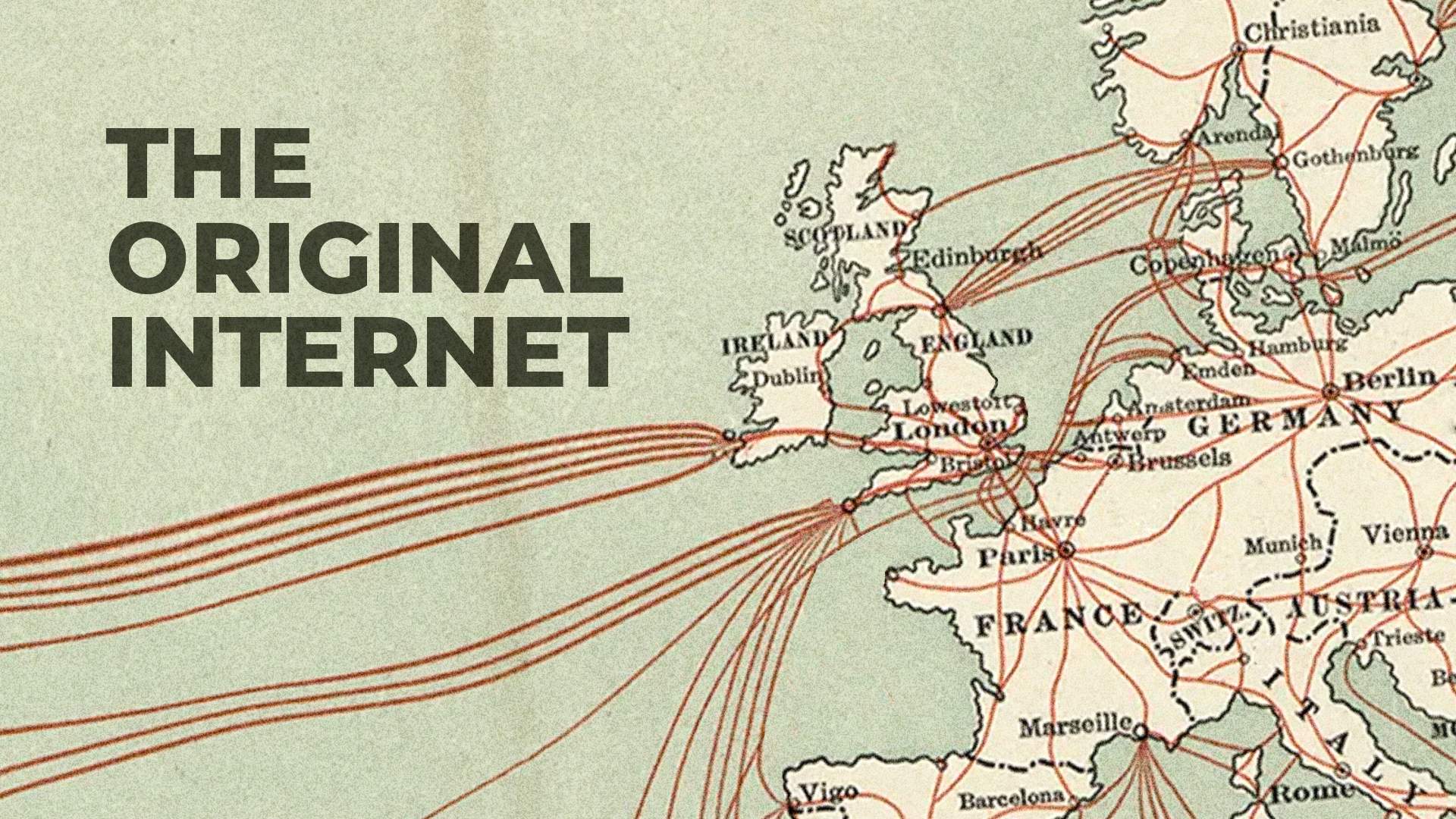
In the 1800s, there were no computers, phones or even light bulbs. But there was an internet – a worldwide web of cables crossing oceans and connecting countries with instant communication. People did business, fell in love and got scammed, just like today. But did we get there?
In the early 1700s, long distance communication was slow. A messenger on a horse could take up to a day just to deliver your letter to the next town. Sending a letter from Europe to America? Don’t expect a reply for another 6 months. It had been this way for all of human existence, but that was about to change.
In 1792, French inventor Claude Chappe set up a series of towers, each with a mechanical arm on top. An operator would control the arms from inside the tower, and by rotating them in different ways, a total of 92 unique signals could be created.
A few miles down the line, the operator in the next tower would look through a telescope and copy the signal. This process would continue down the line, quickly spreading the signal over several miles in just a matter of seconds.
For each word, two signals would be sent. The first would tell the operator which page number to look at in the codebook. The second signal would correspond to a specific word on that page.
Word by word, the message would be sent down the line of towers, and at its destination, each signal would be decoded back into the full message.
Chappe’s system was a huge success, and officially became known as ‘the telegraph’. His towers started spreading all across the country, and even played a huge role in the French Revolution, alerting the government about enemy invasions in a matter of minutes instead of days.
By the mid 1800s, more than 500 of these telegraph towers connected cities all over Europe, covering thousands of miles.
But Chappe’s optical telegraph had its limits. Each tower required employees, making the whole system expensive to run. The towers couldn’t work at night or in bad weather, and they were only really used by governments to send very simple messages.
If there was ever to be a truly fast, long distance communication system for everyone, it would have to be electric.
Dozens of attempts had already been made, but they all ran into the same problems.
The leyden jars that were being used only let out a tiny spark of static electricity, which would struggle to travel more than a few miles. This was eventually solved in 1800, when Allessandro Volta came up with the first ever chemical battery. This could provide a steady flow of electricity, capable of travelling hundreds of miles down a wire.
This is an early electrical telegraph that used 26 wires, one for each letter of the alphabet. At the receiver end, the electric signal would cause a small metallic ball to move, signalling each letter.
This was a step in the right direction, but having a wire for each letter would cost an enormous amount of money when scaled up to a full size line. The key was figuring out how to send information with just a single wire.
In towns all over medieval Europe, church bells had long been used to spread basic information.
To tell the time, the bell would ring on the hour, with the amount of rings matching the number of each hour; four times for 4 o’clock, five times for 5 o’clock and so on.
When someone in the town died, the bell would do multiple slow rings, three times for a man and twice for a woman. After that, the bell would do multiple short rings, to mark the age of the person that died.
If all of this information could be conveyed by simple patterns of bell rings, perhaps the same could be done with electric pulses traveling down a wire.
In order for the electric telegraph to become a reality, scientists had to figure out how to turn pulses of electricity into lines of text. That’s when American painter Samuel Morse entered the race.
Instead of sending individual signals for each letter of the alphabet, he had the genius idea of using short and long bursts of electric signals.
Much like the church bells, different combinations of these signals could be used to send coded messages.
He came up with a simple tapping device that, when pressed, connected the battery into the circuit, sending a signal down the wire. By simply holding the button down for longer, a longer signal would be sent out.
At the receiver end, the signal would turn on an electromagnet, pulling a small pen onto a moving piece of paper and recording the signal as a series of lines.
Together with his engineer Alfred Vail, they developed a code, assigning each letter in the alphabet to a combination of short and long pulses. This eventually became what we know today as Morse code.
Meanwhile, on the other side of the Atlantic, English inventors William Cooke and Charles Wheatstone were about to make their own breakthrough with the electric telegraph.
Their system used a set of 5 needles that could be turned to the left or right via the press of a button. Each letter was arranged in a diamond pattern, and by simply moving two of the needles, any letter could be selected.
Although it required multiple wires and could only include 20 letters, it had one major advantage.
Unlike the Morse telegraph, it didn’t require a complex code book. The letters were visibly selected each time, and anyone could operate the machine without training.
Completely unaware of each other’s progress, both sides set out to get funding for their telegraphs.
But because most people didn’t actually understand electricity, governments and politicians didn’t actually think their machines were real. Since there was nothing visible happening in the wire, people simply thought these were just tricksters trying to make a quick buck.
After a lot of persuasion, Cooke and Wheatstone finally got permission to install their telegraph along a short section of railway in England. It was here that the electric telegraph would finally become famous.
On the 1st of January 1845, John Tawell murdered his mistress and escaped by hopping on a train headed for London. Under normal circumstances, this would have been a guaranteed way to outrun the spread of news. But little did he know about the telegraph, which had just been installed on the exact same train line. After some quick thinking, a police officer sent a description of the man through the telegraph, and the police in London were quickly able to arrest him upon arrival.
The public finally understood how powerful the telegraph could be, and later that year the Cooke and Wheatstone telegraph started being installed all over Britain.
On the other side of the Atlantic, Morse was also finding success, having demonstrated a 40 mile transmission from Washington to Baltimore.
Both countries invested heavily in their telegraphs, and in just a few years, thousands of miles had already been installed, connecting the largest cities together. The next step was obvious, join the two sides together.
With the help of American businessman Cyrus West Field, the Atlantic Telegraph Company was set up, with the aim to lay a 2,000 mile long cable from Newfoundland all the way to Valentia Island just off the coast of Ireland.
Both countries had mastered wiring thousands of lines over land. But making a wire that could survive the corrosive water and curious sea life at the bottom of the ocean was a completely different challenge.
This was the cable they came up with. The core was made from 7 strands of copper wire twisted together and wrapped in 3 layers of rubber to keep it insulated. The cable was then covered in tarred hemp, and wrapped in iron wires to give the cable its protection.
No ship could carry the whole 2,000 mile cable, so it was split into 2 sections and coiled onto enormous barrels inside 2 warships.
On the 29th of July 1858, the two ships met in the middle of the Atlantic ocean and the two cables were carefully spliced together. Both ships then head out in opposite directions, slowly letting the cables drop to the bottom of the ocean. A few days later, both ships arrived at their destinations. They had done it.
For the first time, North America now had a direct communication link to Europe. Information that would have taken weeks and an arduous journey by sea could now be sent in just a matter of minutes.
Over the next 15 years, undersea telegraph cables spread all over the world, connecting Europe to India, Asia, Australia and onto South America.
In just a short period of time, the world had changed forever, and it was all thanks to the incredible engineers that learned to harness electricity.